
Changes in Medicaid Coverage From 2020 to 2025 Reflect Shifts in Program
Overall Medicaid coverage declined between 2024 and 2025 for the second consecutive year, reflecting shifts in Medicaid policy, funding, eligibility and enrollment processes that began in 2020.
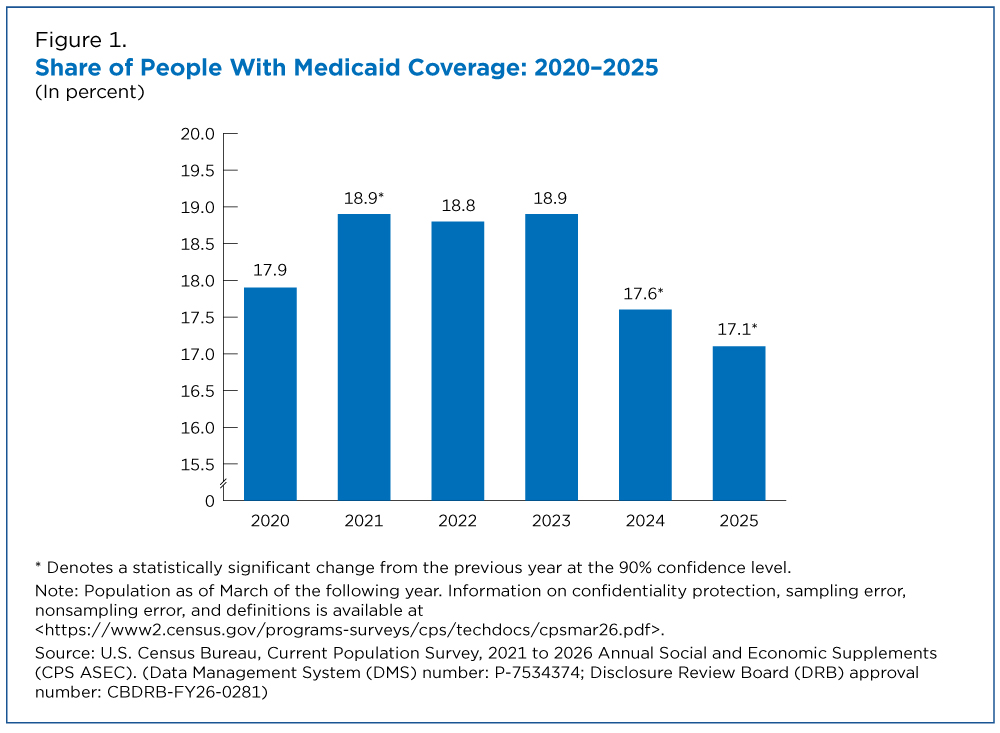
According to the U.S. Census Bureau’s 2021 to 2026 Current Population Survey Annual Social and Economic Supplements (CPS ASEC), Medicaid coverage rates rose from 2020 to 2021, didn’t change significantly from 2021 to 2023 and decreased from 2023 to 2025 (Figure 1).
Medicaid Changes
The Families First Coronavirus Response Act was passed and enacted in March 2020 in response to the COVID-19 pandemic. The measure required states to provide continuous coverage for those enrolled in Medicaid as a condition of receiving increased federal funding for the Medicaid program.
Congress later passed the American Rescue Plan Act of 2021, extending the continuous coverage mandate for the duration of the pandemic. The effects of these policies can be seen in the 0.9 percentage-point increase in Medicaid coverage between 2020 and 2021 and the sustained rates at this level through 2023 (Figure 1).
From 2020 to 2025, Medicaid coverage rates varied across regions. Rates were higher in the Northeast and the West than in the Midwest and the South.
Starting in April 2023, the mandated continuous coverage ended and additional Medicaid funding was gradually reduced and phased out. States began operating under standard eligibility and enrollment processes, which included terminations for individuals no longer eligible for Medicaid coverage.
This return to standard operations is commonly known as Medicaid unwinding. In general, states had 14 months to complete their eligibility and reenrollment processes. Most states, minus a few outliers, completed them by the end of 2024.
The effects of Medicaid unwinding can be seen in the decrease in Medicaid coverage in 2024 and 2025.
The CPS ASEC asks respondents if they had any health insurance coverage in the previous calendar year.
People are considered insured if covered by any type of health insurance, like Medicaid, at any point during the calendar year. An individual is considered uninsured if they had no health insurance at all during the calendar year.
As a result, individuals who lost Medicaid coverage at any point in 2024 due to the unwinding were still counted as having Medicaid coverage that year. Those losses did not show up until the following year — 2025 estimates captured in the 2026 CPS ASEC data released today.
Who Lost Medicaid Coverage?
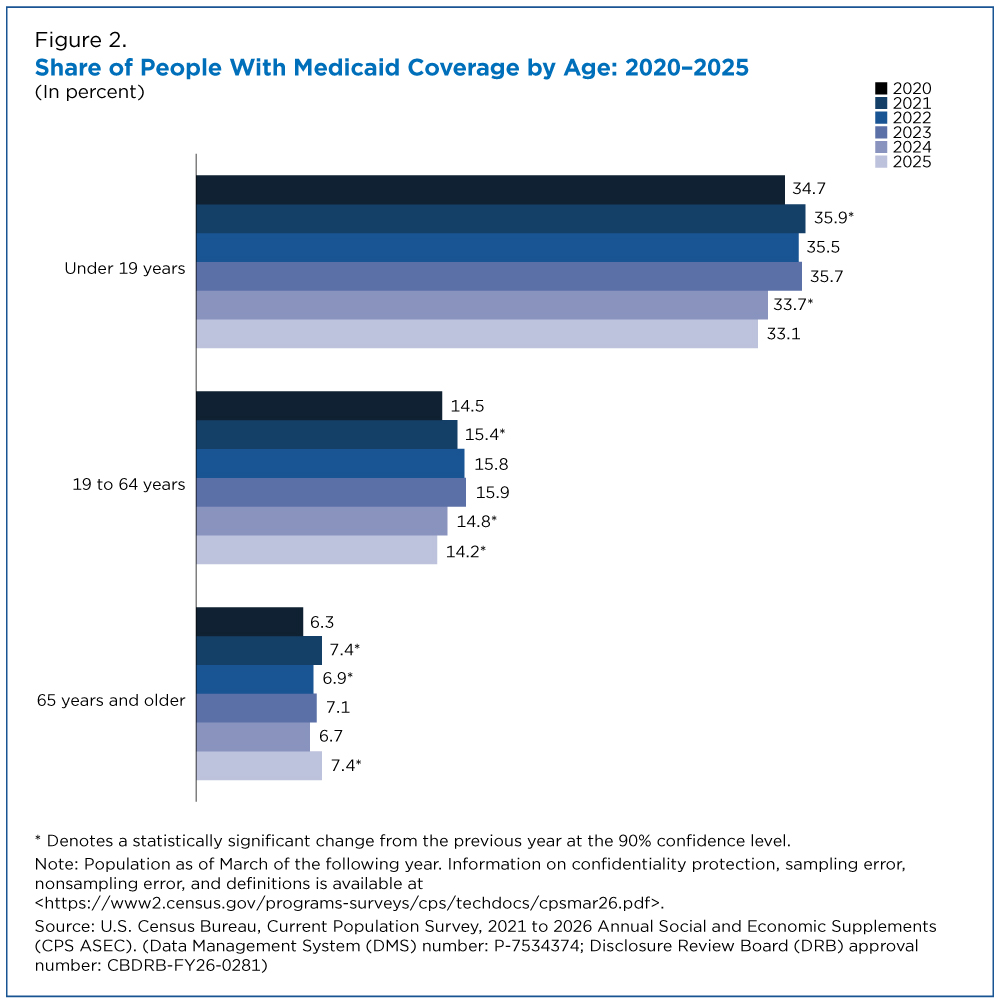
Changes in Medicaid coverage rates from 2020 to 2025 for working-age adults (19 to 64) and children (under age 19) follow a similar pattern as changes in overall Medicaid coverage (Figure 2).
Children experienced a larger drop (2.0 percentage points) than working-age adults (1.1 percentage point) between 2023 and 2024, when the effects of Medicaid unwinding first took hold.
But unlike the total population and working-age adults — whose Medicaid coverage slipped 0.5 and 0.6 percentage points, respectively — children’s coverage didn’t change between 2024 and 2025. This was partly influenced by federal policies extending continuous eligibility and coverage protections for children.
Medicaid coverage of those 65 and older differed from that of other age groups. Their coverage didn’t change significantly from 2023 to 2024 and went up from 2024 to 2025.
Where Did Medicaid Coverage Change?
From 2020 to 2025, Medicaid coverage rates varied across regions. Rates were higher in the Northeast and the West than in the Midwest and the South (Figure 3).
Between 2020 and 2021, when continuous coverage was in effect, Medicaid coverage rates increased in the Northeast and the Midwest but did not significantly change for people in the South and the West.
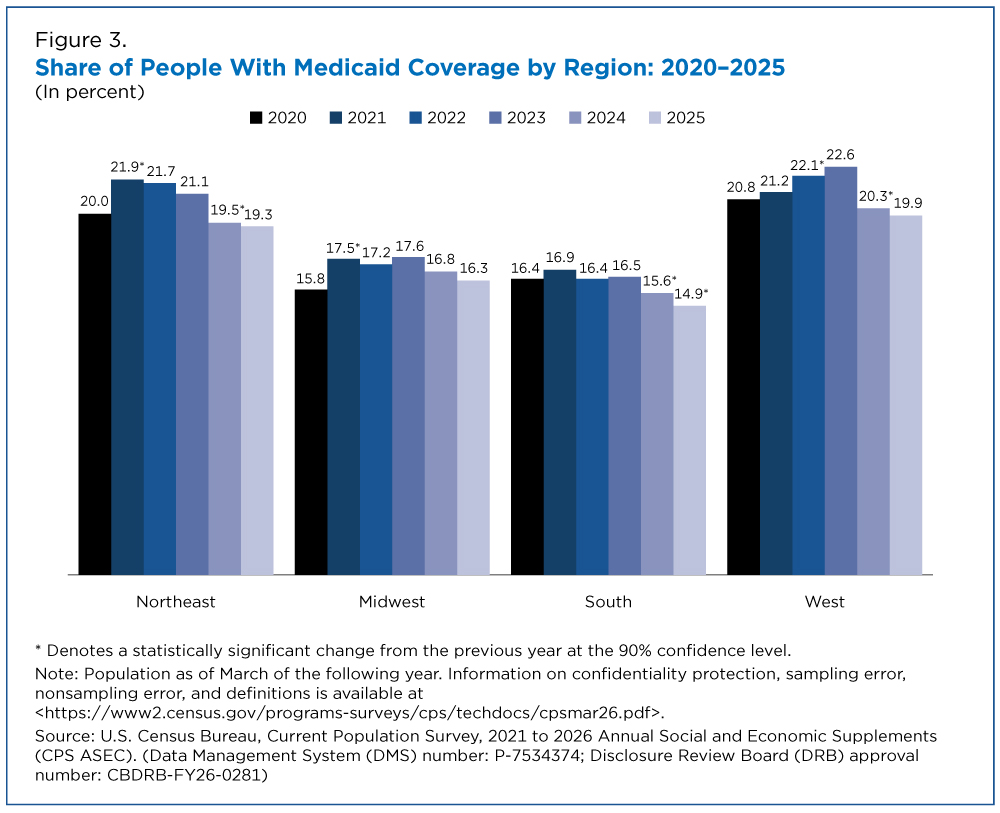
From 2023 to 2024, when the impact of Medicaid unwinding became apparent, Medicaid coverage declined in the Northeast, South and West and did not significantly change in the Midwest. Between 2024 and 2025, Medicaid coverage decreased in the South by 0.6 percentage points, the lowest rate among all regions in 2025 (14.9%).
It is important to note that some states expanded Medicaid eligibility (expansion states) between 2020 and 2025, in accordance with the Affordable Care Act that gave states the option to expand Medicaid eligibility to people who fell under a particular poverty threshold.
As of January 1, 2025, all states in the Northeast, all but one in the West, 10 out of 12 states in the Midwest and 10 out of 17 states in the South had adopted expansion.
The 10 states that had not expanded Medicaid eligibility (nonexpansion states) as of January 1, 2025, were Alabama, Florida, Georgia, Kansas, Mississippi, South Carolina, Tennessee, Texas, Wisconsin, and Wyoming. Of these, seven are in the South, two in the Midwest, and one in the West.
More information on confidentiality protection, sampling error, nonsampling error and definitions is available in the technical documentation. Details in this article may not sum to totals due to rounding. All comparative statements in this article have undergone statistical testing and, unless otherwise noted, all comparisons are statistically significant at the 90% confidence level.
Related Statistics
Subscribe
Our email newsletter is sent out on the day we publish a story. Get an alert directly in your inbox to read, share and blog about our newest stories.
Contact our Public Information Office for media inquiries or interviews.
Related America Counts Stories
-
IncomeU.S. Real Median Household Income Reached Record High in 2025September 15, 2026Real income increased at the top but not the bottom of the income distribution from 2024 to 2025.
-
Income and PovertyHispanic Poverty Rate Reached Historic Low in 2025September 15, 2026The Hispanic population’s poverty rate fell to 13.9%, down 1.2 percentage points from 2024 — still disproportionately high despite being the lowest on record.
-
Income and PovertySupplemental Poverty Rate Tops Official Rate in 26 States, DCSeptember 15, 2026Louisiana had among the nation’s highest poverty rates by both the official poverty measure and the Supplemental Poverty Measure.
-
Income and PovertySupplemental Poverty Rate Tops Official Rate in 26 States, DCSeptember 15, 2026Louisiana had among the nation’s highest poverty rates by both the official poverty measure and the Supplemental Poverty Measure.
-
IncomeU.S. Real Median Household Income Reached Record High in 2025September 15, 2026Real income increased at the top but not the bottom of the income distribution from 2024 to 2025.
-
Health InsuranceMedicaid Coverage Declined in 2025 for Second Year in a RowSeptember 15, 2026Changes in policy, funding, eligibility and enrollment processes that began in 2020 contributed to decline in Medicaid coverage.
-
Income and PovertyHispanic Poverty Rate Reached Historic Low in 2025September 15, 2026The Hispanic population’s poverty rate fell to 13.9%, down 1.2 percentage points from 2024 — still disproportionately high despite being the lowest on record.